

Trans-boundary Air Pollution – The Untold Story
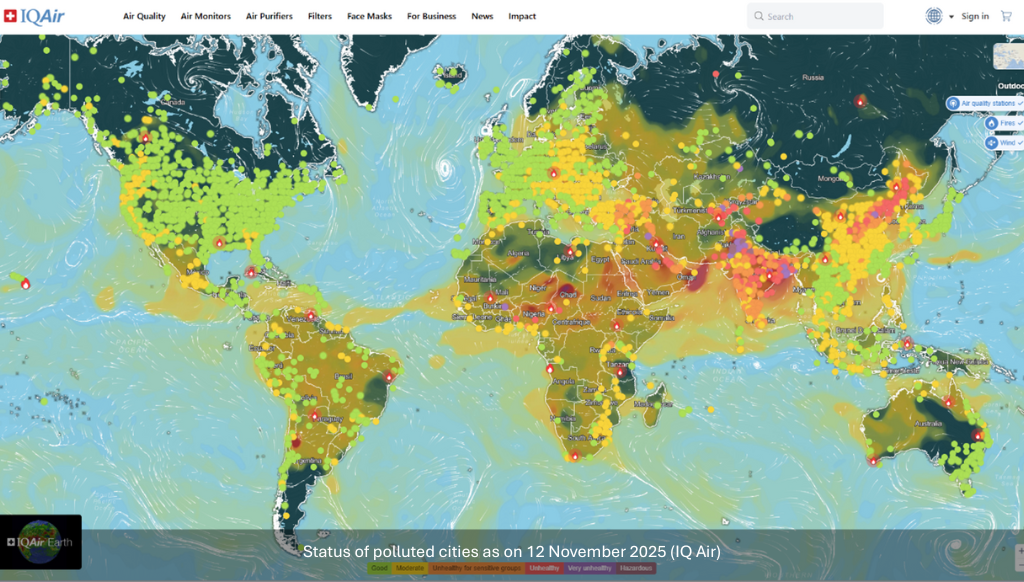
In 2024*, around 8.1 million people died globally due to air pollution. After cardiovascular disease, exposure to toxic air is the second leading cause of death across all age groups. It acts as a silent killer, contributing to heart disease, stroke, lung cancer, diabetes, and chronic obstructive pulmonary disease (COPD) (State of Global Health Report, 2024). Poor air quality is a significant global issue. The World Health Organisation (WHO) estimates that 99% of the world’s population lives in areas with air quality below the recommended limits.
The situation in the world’s most populous country, India, is quite alarming. A new study published in 2025 found that long-term exposure to air pollution results in an additional 1.5 million deaths per year in India, compared to what might occur if India met the WHO’s recommendations for safe air quality. The situation is particularly serious for infants. According to the State of Global Health Report, 2024, approximately 464 children under the age of five die every day in India because of toxic air quality. It is important to note that the right to breathe clean air is recognised as a fundamental right in India under Article 21 of the Constitution, which guarantees the right to life. As demonstrated in the map, Asia, led by India, is among the regions most severely affected by air pollution. While Delhi often makes headlines each year, air quality is an issue throughout India and beyond its boundaries. This is evident on the air pollution map of India, which shows that many cities across the country are highly polluted, especially during the winter season. In the National Capital Region, the major sources of air pollution include transportation, road dust, power plants, construction, diesel generators, vehicles, crop burning, household emissions, and various industries. The problem is even exacerbated by the city’s existing policies. For example, during times of high air pollution, sweeping roads with brooms in the early morning creates more dust and worsens air quality. Instead, using vacuum suction to clean the roads would be a more effective solution. The collected dust can be repurposed for beneficial uses, thanks to technology developed by TARA.
The Indo-Gangetic plains in India serve as a significant hub of air pollution. The major sources of this pollution include industrial activities, thermal power plants, brick kilns, cookstoves, open fires, and transportation. However, the issue of transboundary air pollution is often overlooked in the region. Pollution from neighbouring countries such as Afghanistan, Pakistan, Bangladesh, and India flows across each other, aggravated by the air flow patterns, as illustrated in air quality maps. Pakistan, especially areas like Lahore, Bahawalpur, and Multan, is a major source of pollution, with contaminated air coming from various directions. As the air flows from west to east, these pollutants also move through India, increasing pollution levels in the Indo-Gangetic plains and the Terai regions of Nepal and Bhutan. Additionally, polluted air flows into Bangladesh and vice versa. The distribution of these pollutants is influenced by airflow patterns, which can vary throughout the day and across different seasons.
Transboundary air pollution refers to air pollution that does not stop at national boundaries but continues to cross them. Both countries and regions are affected by the movement of this contaminated air. Industrial and household activities release fine particulate matter and other harmful gases into the atmosphere, where they can remain suspended and travel long distances. Research has shown that high emissions of particulate matter and black carbon are significant contributors to the melting of glaciers in the Himalayas, aggravated by transboundary pollution.
A WHO report on the health risks of particulate matter from long-range transboundary air pollution confirms that particulate matter generated by various human activities can travel long distances in the atmosphere. This pollution leads to a wide range of diseases and significantly reduces life expectancy in many populations across affected regions.
All governments in the affected regions of South East Asia recognise their regional responsibility to address air pollution and are taking steps to reduce it. However, there is a need for coordinated efforts among all countries. Intergovernmental organisations, such as ICIMOD, UNDP, ADB, and the World Bank, could establish a transboundary air pollution agenda. This agenda would focus on raising awareness, implementing technological solutions, developing policies and cooperation strategies, sharing best practices, and applying successful approaches in respective areas. These efforts will not only save human lives but also lower healthcare costs by reducing hospitalisation rates. Furthermore, it will contribute significantly to global efforts to reduce carbon and other aerosol emissions, benefiting both the environment and the public health. Most importantly, gathering data at regional, national, and local levels is essential before effective mitigation actions and strategies can be formulated.
The views expressed in the article are those of the authors and not necessarily those of Development Alternatives.
This blog first appeared as an editorial in Development Alternatives Newsletter December 2025
Clean Tech Enterprises: Reimagining Clean Air Through Clean Technology



Leave a Reply