

From Information to Ownership: How Community Media Drives Change
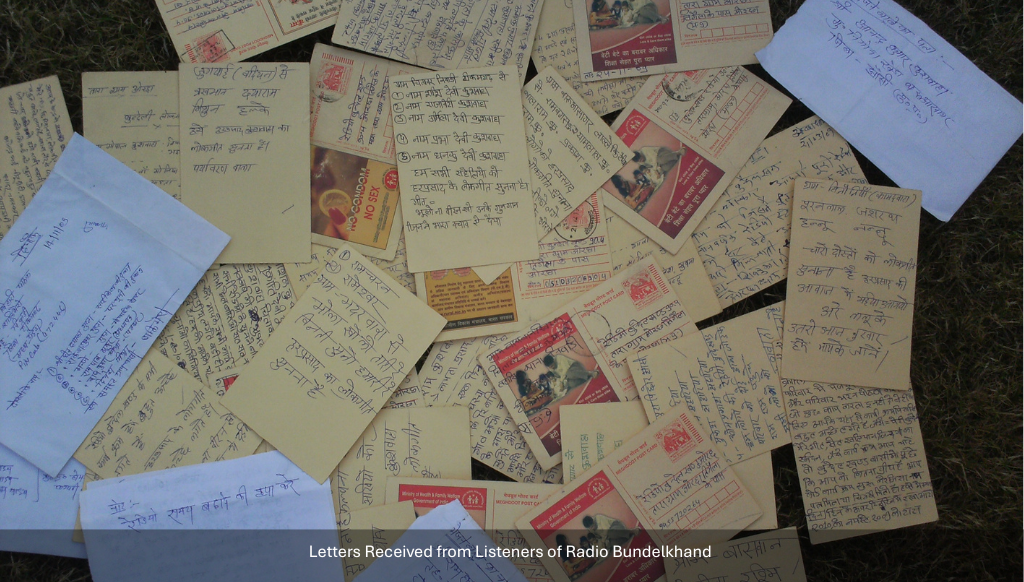
Community media is quietly reshaping how villages perceive climate and development. In regions where climate change is no longer just an abstract concept and where technical reports, policy language, and urban narratives often fail to resonate, locally rooted media have emerged as a vital bridge between complex interventions and everyday life. This is where community media platforms such as Radio Bundelkhand, play an essential role, serving as last-mile delivery bridges that help connect communities to access public information, services, and technical solutions.
When Climate Change Becomes Local News
At the core of this role is climate resilience. For communities facing erratic rainfall, groundwater depletion, rising heat stress, and changing agricultural patterns, resilience is more than just a policy term; it is a daily concern. Community media addresses these issues and helps them create practica understanding and solutions. It disseminates information on development interventions such as climate friendly agricultural practices, water conservation, waste management, sanitation, health, and governance in a way that is accessible, avoiding complex terminology and institutional jargon.
By using familiar voices, local dialects, and shared references, these messages resonate more deeply with the community. For instance, when a farmer hears another farmer discussing changing cropping practices, or when a Jal Sakhi explains safe water habits in her own words, the message feels credible and achievable.
Voices That Villages Trust
What makes community media powerful, is not just dissemination but also participation. Issues are presented not as isolated topics but as interconnected elements of everyday life.
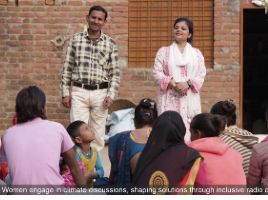
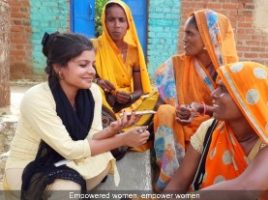
For example, conversations about safe drinking water are naturally linked to sanitation practices and women’s health. Discussions on agriculture include climate-resilient crops, soil health, and water-efficient practices. Health programming creates opportunities to address topics like heat stress, nutrition, menstrual hygiene, and preventive care-subjects often shrouded in silence or stigma. Community media fosters a familiar, non-threatening environment where women can talk to other women, farmers can learn from one another, and frontline workers can engage with their neighbours as equals. In this context, information transforms from external advice to shared understanding
Crucially, community media is fundamentally about two-way communication, not just one-way broadcasting. Radio Bundelkhand employs a participatory programming model that includes call-ins, local voices, community reporters, field-based recordings, and listener feedback.
This approach has helped the station establish a strong, two-way relationship with the people of Bundelkhand. Listeners are not mere passive recipients; they actively shape content, raise questions, share their experiences, and challenge narratives. This ongoing dialogue allows the radio station to remain connected to real concerns while reflecting the community’s realities. Over time, this participation fosters trust, relevance, and a sense of ownership that no top-down messaging can achieve.
This approach spans various programmes and sectors. Efforts to restore natural ecosystems are more effective when communities understand the importance of water conservation beyond just irrigation. Initiatives focused on resource access and equity are more successful when women are engaged in open, stigma-free discussions about water, sanitation, and health. Community resource management becomes sustainable when local groups share and learn from each other’s experiences.
Linking Villages to Systems of Power
This participatory approach also strengthens governance and improves access to institutions. Community media plays a critical role in linking people with government schemes, announcements, state functionaries, and public systems that often seem distant or hard to navigate.
Information about entitlements, application processes, grievance mechanisms, and local governance structures becomes clearer when presented in simple, honest terms on familiar platforms. Dialogues with panchayat representatives, district officials, health workers, legal experts, and even police help demystify these systems and reduce fear or misinformation. As a result, people grasp processes better, ask informed questions, and engage more confidently with institutions.
The media, in this sense, does not replace governance; instead, it facilitates connections between people and their governing bodies.
What this really demonstrates is that development outcomes are shaped not only by infrastructure or funding, but also by communication that fosters understanding, participation, and trust. It shows that community media fosters ownership by centring local voices, respecting lived experiences, and making knowledge accessible without compromising its seriousness. When villages see their own stories reflected in narratives of change, they engage more deeply, adapt more quickly, and sustain progress longer. They do not simply wait for solutions; they start to shape them, building resilience that is social, institution-al, economic, and ecological all at once.
The views expressed in the article are those of the authors and not necessarily those of Development Alternatives.
This blog first appeared as an editorial in Development Alternatives Newsletter February 2026
Community Media for Climate and Development

Leave a Reply