

The Quiet Architecture of Shaping Inclusive Rural Entrepreneurship
In Jhansi, Uttar Pradesh, Suman Gautam’s working life grew slowly and within limits she did not choose. Married young, with little mobility and few income options, she began earning through small economic activities connected to a self-help group in her village. The income helped stabilise her household, but markets were distant and growth felt risky. Each step beyond the familiar required time, money, and negotiation with family, with transport, with opportunity itself.
Buying an e-rickshaw and learning how to drive it shifted those boundaries. Mobility allowed Suman to reach markets on her own terms and she began distributing sanitary pads across neighbouring villages. What started as a way to move goods gradually became a way to build relationships and confidence. Today, her distribution network spans over 30 villages, and she manages both her e-rickshaw and sanitary pads distribution enterprise while actively encouraging other women to explore livelihoods that once felt inaccessible.
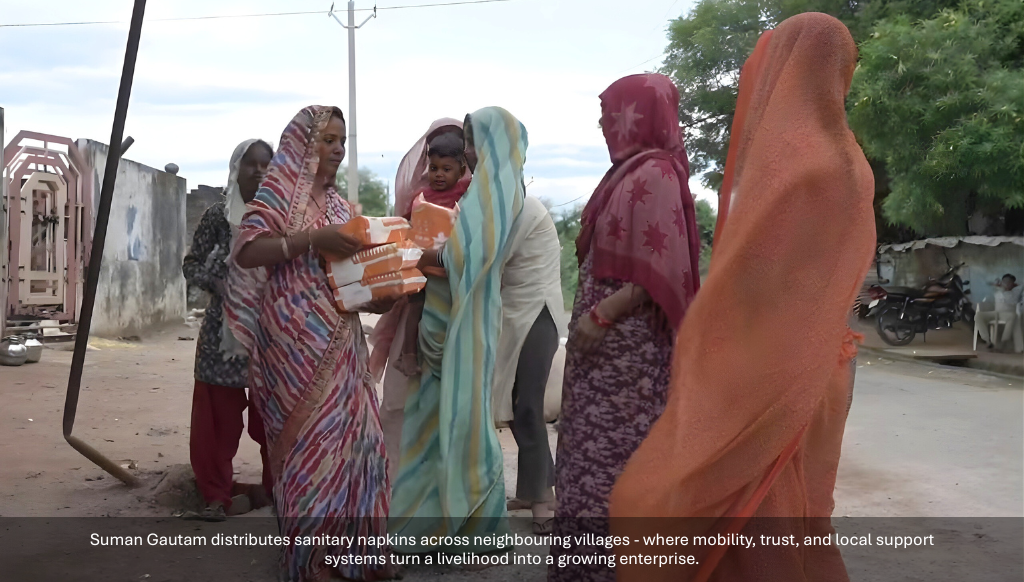
Over the past seven years, similar journeys have accumulated across districts where enterprise ecosystems are being strengthened. More than 61,000 enterprises have been supported, generating over one lakh jobs and touching 406,000+ livelihoods.
Suman’s journey draws attention to how enterprise growth, especially in the non-farm sector, actually unfolds on the ground. It rarely depends on a single scheme or intervention. Instead, it reflects how social reality interacts and different forms of support such as skills, technology, finance and eventually community institutions and local administration come together.
This is where local entrepreneurial ecosystems begin to matter. When services operate in silos, the responsibility for coordination falls squarely on entrepreneurs, often those with limited mobility, time, or bargaining power. The cumulative effect is caution: smaller risks taken, slower decisions, and enterprises designed to survive rather than expand.
Districts: Where Systems Converge and Deliver
What is needed, then, is not another intervention layered onto this complexity, but a way of reorganising how existing actors, resources, and decisions come together at the district level. Districts matter because it is at this level that processes can move beyond top-down delivery, allowing district agencies to stay closely connected to ground realities, emerging needs, and opportunities that often remain invisible from higher tiers.
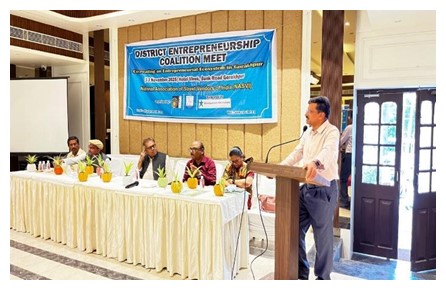
Dr. Mangalesh Srivastava, Mayor of Gorakhpur, addressing the District Entrepreneurship Coalition, signalling municipal support for integrating street vendors into the city’s enterprise ecosystem.
The District Entrepreneurship Coalition (DEC) brings together government departments, financial institutions, enterprise support organisations, and community institutions into a shared platform at the district level. It creates a space where decisions are shaped by real enterprise journeys, and where different parts of the system respond in coordination. For example, in Mirzapur, the DEC enabled microfinance institutions to reassess their lending practices, leading to more appropriate loan terms and interest rates that made credit more affordable and accessible for micro and nano entrepreneurs.
For entrepreneurs like Suman, this changes how opportunities unfold. Pathways to finance, market linkages, and enterprise support become clearer when actors engage in a shared space rather than through disconnected processes.
It is within this platform that different parts of the ecosystem begin to align. Last mile actors contribute insights from everyday interactions while grassroots entrepreneurs bring the lived realities of their work into system-level discussions. This convergence enables more grounded decision-making and strengthens how systems respond to emerging needs.
Over time, such coordination reduces uncertainty, improves responsiveness, and allows enterprise growth to become more consistent across the district they are built in.
Collective Action through Partnerships
It takes more than one institution to create a portfolio of solutions that can respond to the diverse and evolving needs of entrepreneurs.Partnerships such as those with Haqdarshak and the National Association of Street Vendors of India (NASVI) bring this portfolio to life.
Through Haqdarshak’s network of trained nanoentrepreneurs, last-mile access to formal systems becomes simpler and more reliable, enabling processes such as Udyam registration, PAN applications, and scheme enrolment to move from awareness to action. Their presence also creates feedback loops that help systems respond to recurring challenges faced by first-time users.
NASVI’s work with street vendors reflects how access, when combined with collective organisation, begins to shape behaviour and identity. Vendors connected to training, formal credit through PM SVANidhi, and municipal systems engage more actively with their enterprises. Collective platforms and town-level federations further strengthen peer learning and shared voice, allowing informal work to organise and participate more visibly in local economies.
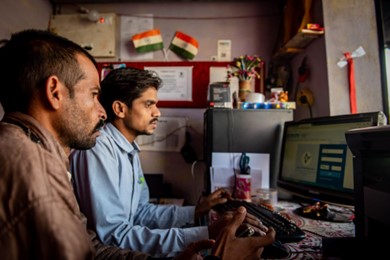
At the last mile, access becomes action – making registrations, schemes, and enterprise support services simpler, closer, and truly usable.
The Mirzapur Case Study
These dynamics become more visible when seen over time within a single geography. Since 2017, Mirzapur has been a strong operational foothold, offering a clear view of systemic change when enterprise development is approached through an ecosystem lens.
The district aligns strongly across three critical dimensions: institutional readiness, market potential, and visible aspiration among women and youth to engage in entrepreneurship. The Bhadohi–Mirzapur carpet industry anchors a strong economic base, while a growing network of textile and apparel units continues to open non-farm opportunities.
What followed was a more deliberate organisation of what already existed. Market opportunities were mapped through an understanding of household consumption, production gaps, and enterprise density. Rising spending on food products, services, and digital access signalled expanding local demand, while gaps in sectors such as dairy, repair services, and affordable consumer goods pointed to clear entry points for new enterprises.
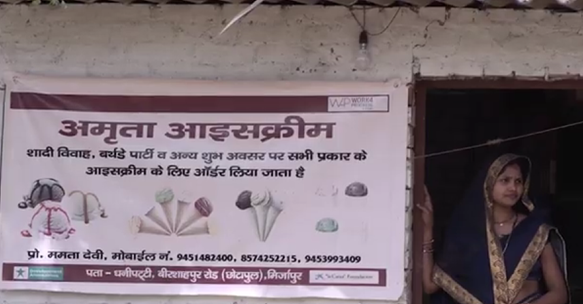
Where local demand meets women’s aspirations – ‘Amrita Ice Cream’ is a sweet example of an enterprise thriving in Mirzapur.
This allowed enterprise promotion to move with greater precision. Small-scale ice cream enterprises, for instance, were introduced where improved electricity, stable demand, and access to dairy value chains made them viable. Even modest market capture within a limited radius translated into steady incomes, demonstrating how local demand, when understood well, can sustain enterprise growth.
Over time, stronger coordination across departments has made access to schemes more direct and reduced dependence on intermediaries. Implementation timelines have shortened, and outreach through women’s institutions has deepened, extending into communities that were previously underserved. What emerges is a system that is becoming more responsive, coordinated, and capable of supporting enterprise growth at scale.
Embedding into Public Systems and Policies
As these shifts stabilise at the district level, their continuity depends on how deeply they are embedded within public systems.
Uttar Pradesh State Rural Livelihood Mission (UPSRLM) adoption of DA’s approach to entrepreneurship strengthens how public systems engage with entrepreneurship on the ground, where women’s institutions such as Cluster Level Federations, district platforms, and converging support systems work together to make enterprise growth scalable.
Enterprise promotion becomes part of the ongoing work of SHGs and CLFs, where women’s collectives identify aspiring entrepreneurs, anchor support services, and co-create pathways for enterprise journeys within their communities. Within these institutions, systemic prototypes such as Kaun Banega Business Leader and Udyamita Suvidha Kendras are anchored by CLFs, as living spaces where ideas are tested, refined, and carried forward collectively.
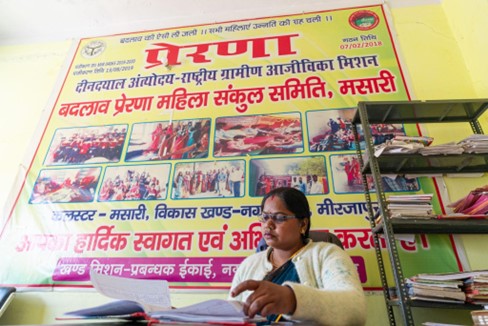
Savita Saroj of the Badlaav Cluster Level Federation in Mirzapur advancing entrepreneurship through collective action under the Uttar Pradesh State Rural Livelihood Mission framework.
A CLF manager in Mirzapur once described the moment a business idea begins to take form during a comic workshop . A room that begins in hesitation slowly fills with conversation, with women tracing possibilities in stories, recognising their own lives in them, and then, almost
- Kaun Banega Business Leader’ (Who Will Be the Business Leader), is a unique competition designed to channel entrepreneurial ideas into actionable business plans. This interactive process not only inspires confidence but also encourages a spirit of innovation among participants.
- An Udyamita Suvidha Kendra is a CLF-anchored, one-stop support platform that enables entrepreneurs to start, formalise, and grow their enterprises. It integrates business planning, administrative support, access to finance, and market-linked capacity building to deliver sequenced, stage-appropriate support within local entrepreneurial ecosystems.
- Comic Workshop is a creative social innovation tool that allows the participants to channel emotions and comprehensively narrate their journey from childhood to entrepreneurship to visualise their dreams and explore potential business ideas in an accessible and engaging manner.
gently, beginning to speak of what they could build. “You can see the shift,” she says, “when an idea stops feeling distant and starts feeling like it belongs to them.”
It is in these moments that systems begin to root themselves locally. Enterprise is no longer introduced from the outside; it is shaped, held, and carried forward within institutions that people trust. Over time, this institutionalisation builds continuity. Enterprise support moves through networks that have both legitimacy and reach, allowing efforts to deepen, travel across geographies, and remain anchored in the everyday realities of those they are meant to serve.
SAM-UDYAM and the Architecture of Scale
What emerges across these layers – from individual journeys to district platforms to public systems is a pattern of how scale is actually built.
In this emerging landscape, inclusive entrepreneurial ecosystems appear less as formal structures and more as everyday arrangements of relationships, coordination, and shared problem-solving that build momentum over time. Platforms such as the District Entrepreneurship Coalition and the wider SAM-UDYAM collaboratory are part of this work as ways of holding systems together as they evolve.
- SAM-UDYAM, an inclusive entrepreneurship collaboratory (collaborative-cum-laboratory), brings together diverse actors to collectively address structural barriers to entrepreneurship. Through shared learning, innovation and collaboration, it aims to enable systemic shifts that expand opportunity- driven enterprises, strengthen local economies, and promote equitable and resilient livelihoods, especially for women and youth.
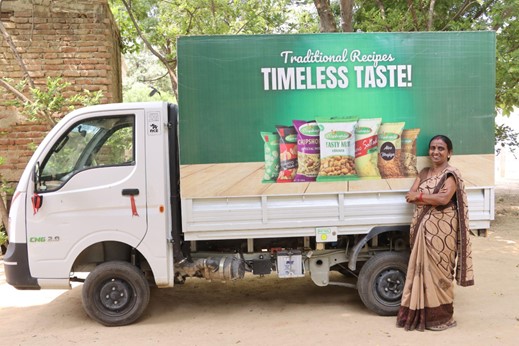
In Mirzapur, Shashibala Sonkar – founder of Chipshophile, a local namkeen manufacturing unit, embodies the micromovements that quietly transform systems stitching new futures into the local economy.
The SAM-UDYAM and our One Million Livelihoods by 2030 mission is best understood as an architecture for enabling thousands of micro-movements of change. Each district platform strengthened, each enterprise pathway clarified, and each local intermediary empowered contributes to a larger shift in how livelihoods take root and grow. These micromovements – quiet, cumulative, and grounded in lived realities – are where scale is actually built.
Related posts:
 Finance that Builds Futures: Reimagining Capital to Unleash Inclusive Entrepreneurship
 The Non-Farm Imperative: Rural Women Entrepreneurs and the 2030 Jobs Mission
 Bridging the Divide: Digital Infrastructure Paving the Way for Rural Entrepreneurship-led Job Creation
 Empowering Rural Women: A Catalyst for Global Change
Leave a Reply