

40 Years On: The Green Transition Has Always Been About People
In 1982, when Development Alternatives was founded, the vocabulary that governs India’s recent development ambitions did not yet exist. Sustainable development had no official definition. That would come five years later, in the Brundtland Commission’s landmark report – Our Common Future. Green jobs, circular economy, sustainability itself: none of these were policy categories or development imperatives.
The founding premise of Development Alternatives was straightforward, but at the time, also radical: that development, to be worthwhile, had to be simultaneously ecologically sound, socially equitable, and economically viable. If a clean technology couldn’t generate a livelihood, it wasn’t clean enough. If a livelihood couldn’t sustain itself beyond the project cycle, it wasn’t a livelihood. If sustainability came at the cost of the social fabric that made it possible, it was meaningless. This was the bet we placed.
In the 1980s, the response to housing shortage in India’s construction sector was predicated upon the widespread use of cement, steel, and aluminium — energy-intensive materials that were also unaffordable for most families. The TARA Balram Mudblock Press, launched in 1984, responded with compressed earth: no firing, no cement, no industrial supply chain, built from what was already underfoot. A decade later, Micro Concrete Roofing, an energy-efficient and eco-friendly technology, extended the same logic to building durable, cost-effective homes.
From that first question of what happens when you build with what you have, others followed naturally. The TARA Chulha freed women from hours of gathering biomass and from the respiratory distress and even deaths caused by an open fire.
In 1995, all of these threads found a home in Orchha. TARAgram, established on the banks of the Betwa in Madhya Pradesh, became India’s first appropriate technology demonstration village — bringing technology, community governance, ecological design, and enterprise viability into one place to test each other over time. Even earlier, in 1991, the women-owned handmade paper had demonstrated this integrated thinking in practice, transforming waste paper and agro-residue into commercially viable products — an early expression of what would later be termed a circular economy enterprise.
In 1996, the DESI Power biomass gasifier came to life – India’s first decentralised biomass power plant, generating electricity for the surrounding communities from local biomass. The technology was specific to its moment, but the question it was asking was timeless: what does it mean for a community to own its own energy? What kinds of livelihoods become possible when power is reliable, affordable, and locally controlled?
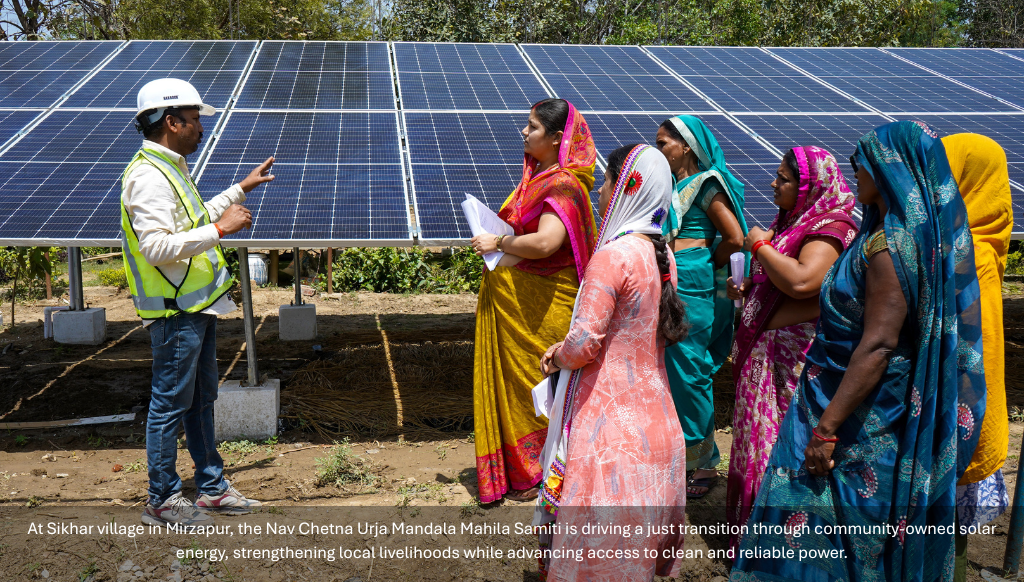
Those questions were the same question asked in 2012 when TARA anchored the Smart Power for Rural Development Programme establishing solar micro-utilities that brought clean, affordable, and reliable electricity to off-grid or energy-deficient rural communities. Today, Urja Mandala – women-led, community-governed decentralised energy enterprises operating across eight sites in Uttar Pradesh and Jharkhand, are changing the energy economics of the rural micro-enterprises they serve. Some thirty years span these two moments. Technology has changed; the underlying logic has not.
In 1998, TARA Eco Kiln – the Vertical Shaft Brick Kiln, became one of the first bundled Clean Development Mechanism registered projects in India, making carbon credits available to small-scale brick producers. TARA Machines carried this logic further still, developing fly ash brick technology that converts India’s 300 million tonnes of annual thermal power waste — a respiratory hazard with massive disposal costs into high quality building material.
DA understood that the transition to cleaner production was not only an ecological imperative but an economic opportunity and that small enterprises, given the right technology and the right support structure, could access that opportunity before large ones did.
As people’s ability to innovate increases and many more solutions emerge, the current emphasis of DA’s work is at the meso-level, aiming to build systems that close the distance between a national ambition and the person it is meant to serve.
This work is enabled through improved access to technology and stronger entrepreneurship ecosystems. Platforms such as the Technology Acceleration Platform for Rural Innovation and Social Entrepreneurship (TAP-RISE) connect technology developers, enterprise ecosystem actors, and grassroots organisations to transform proven innovations into sustainable rural enterprises through mentoring, technology validation, capacity building, and market linkages. The udyaME platform provides end-to-end entrepreneurial support, from personalised mentoring to strategic market access while District Entrepreneurship Coalitions (DEC) brings together banks, government departments, skilling institutions, market actors, and civil society organisations to collaboratively address systemic barriers and strengthen inclusive entrepreneurship ecosystems.
Today, as the vocabulary of green jobs gains prominence in institutional, financial and business radar screens, it is worth remembering that the person at the heart of climate action does not need to be handed down benefits. She should rightfully claim ownership in ventures – entrepreneurial and community-led that change lives and create a better world for our children. The green transition was always about people. Forty-four years of this work is simply the beginning – evidence that should not be ignored.
The views expressed in the article are those of the authors and not necessarily those of Development Alternatives.
This blog first appeared as an editorial in Development Alternatives Newsletter June 2026 The people powering India’s just transition.
Leave a Reply