

The Borrower the System Forgot to Design For
Somewhere in rural India right now, a woman is being turned down for a loan of about ₹1.5 lakh. She has never missed a repayment. Her business has a track record that could be easily verified—if anyone asked to see it. She will likely walk away from that bank without the money. The reason has little to do with her risk profile and more to do with the fact that nobody has designed a product, process, or credit model with her in mind.
That is the paradox at the centre of this edition. Rural women entrepreneurs face a financing gap exceeding 70%, despite consistently strong repayment performance, with delinq-uency on individual enterprise loans running as low as 0.16 % [1]. Put those two facts side by side and the usual explanations—that this is a demand problem or a ‘creditworthiness’ problem—begin to fall apart. What we are looking at is a design problem: a financial system built around a borrower who looks, earns, and documents her economic life very differently from the women actually knocking on its door.
We call this the missing middle, and it is worth saying plainly that it extends beyond women. Any small enterprise that has outgrown a microfinance loan but has not yet become legible to a bank sits in this same gap. This edition examines that gap through the lens of rural women for two reasons. First, their record of reliable repayment, visible ambition, and demonstrated ability to turn small capital into growing enterprises merits attention in its own right. Second, our work in Uttar Pradesh is showing why closing this gap is central to the state’s own growth ambitions.
Consider what is already happening in the districts where Developmet Alternatives works. Across Jhansi, Mirzapur, Lucknow, Varanasi, Gorakhpur, Prayagraj, Kaushambi, Sonbhadra, Sant Ravidas Nagar, Sitapur, Lakhimpur Kheri, Deoria, Nalanda, and Gaya, more than 46,000 women-led enterprises have taken shape in just the past year, across 83 blocks. That is more than a statistic; it is evidence of a vast pool of entrepreneurial capacity that formal systems have barely begun to recognise. Uttar Pradesh’s first economic survey charts a path from a gross state domestic product of roughly ₹30 lakh crore today towards a trillion-dollar economy [2]. At the national level, India needs to create close to 78.5 lakh non-farm jobs every year through 2030. Rural women’s enterprises can play a crucial role in meeting that challenge. Women in rural India are already building businesses, creating livelihoods, and contributing to local economies. What they need now is a system capable of recognising, supporting, and scaling what they have already begun. Let me make this concrete with one story.
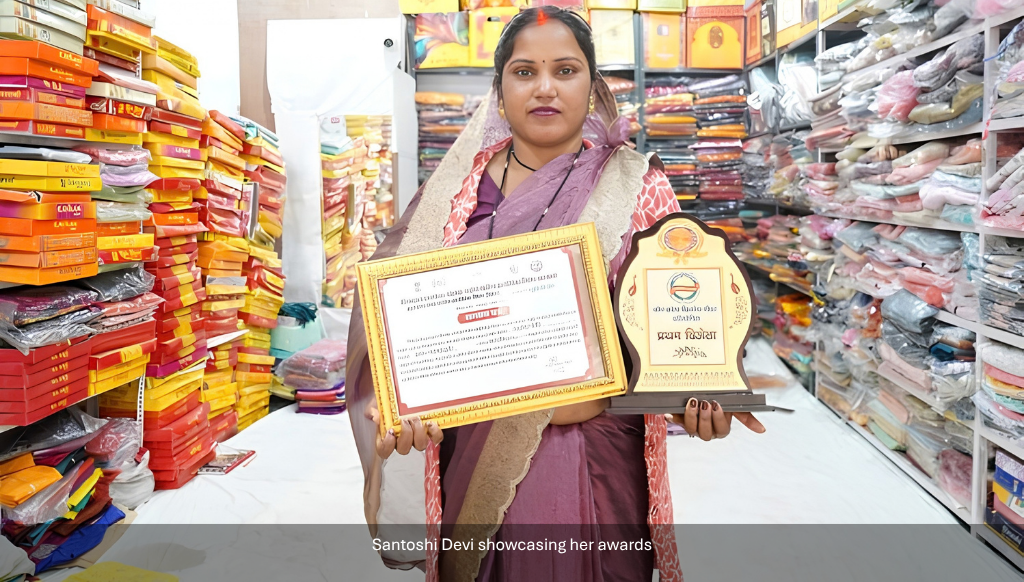
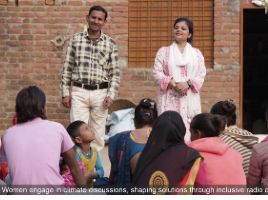
Santoshi lives in Sant Ravidas Nagar, in Bhadohi. And until recently, her working life revolved around helping at her husband’s shop, which brought in ₹10,000 a month. What changed first was the environment of solidarity built within her community. It gave Santoshi something no loan could: the confidence to build a business of her own. An initial loan of ₹80,000, facilitated through a peer-to-peer social investment platform, enabled her diversify the shop’s offerings, doubling household income. A second loan, this time ₹4.5 lakh under the state’s Chief Minister Yuva Udyami Yojana helped stabilise the enterprise and prepare it for expansion. Today, her shop supports three more livelihoods beyond her own family’s. She is already talking about opening a second outlet, and after that, a mall! Sit with what actually moved here. It was a sequence of loans, each sized to where Santoshi’s business genuinely stood at that stage, delivered through people and institutions that came through for her. Since 2018, we have seen building the case for what redesigning that finance could look like, and the evidence is no longer anecdotal. Thousands of women like Santoshi are ready to absorb capital productively at each stage of growth. We also see something harder to quantify but no less real: community intelligence, the accumulated local knowledge of who is creditworthy, held within Self-Help Groups and Cluster-Level Federations long before it reaches a bank’s ledger.
On paper, India already has instruments that could serve this segment: Micro Units Development and Refinance Agency loans, Stand-Up India, the Pradhan Mantri Formalisation of Micro Food Processing Enterprises scheme, Start-up Village Entrepre-neurship Programme’s interest-free credit through National Rural Livelihoods Mission, among others. What our work keeps surfacing is that the real shortfall sits elsewhere: in the connective tissue, the shared credit histories, facilitation, and pathways that would allow a woman like Santoshi to move smoothly from ₹80,000 to ₹4.5 lakh and, eventually, to whatever capital her mall might require. Building that connective tissue is well within reach. It simply has not yet been anyone’s job.
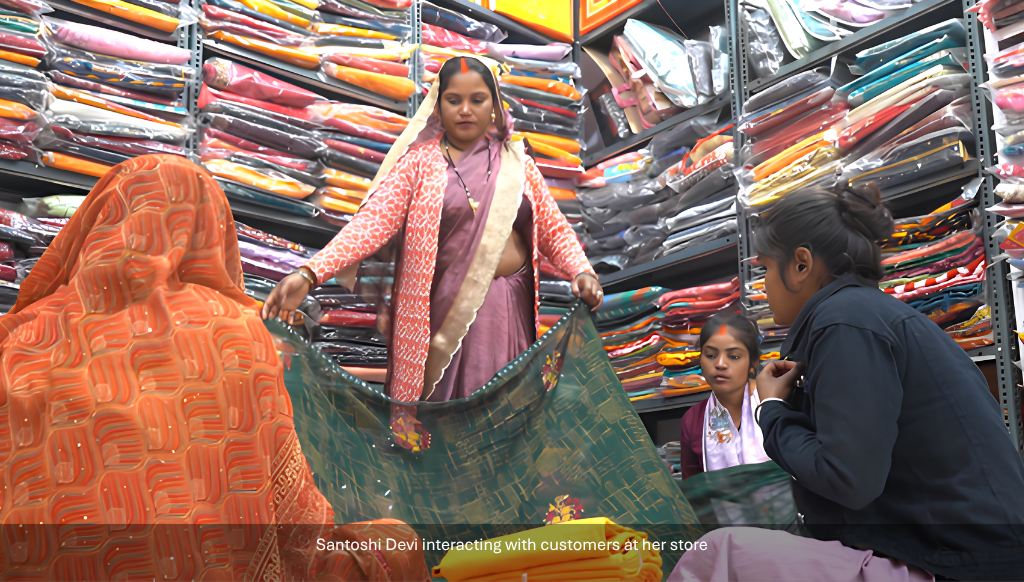
This is also why we keep insisting that the ambition on the ground points towards growth. Women are adopting digital tools, reaching new markets, building enterprises in ways that a subsistence framing often overlooks. As each woman grows her enterprise, she becomes a more active participant in her local economy. Multiplied across thousands of enterprises and communities, that participation strengthens local markets and contributes to the same economic ambitions reflected in Uttar Pradesh’s gross state domestic product targets and India’s broader sustainable development goals. An economy cannot compound its growth while a large pool of potential entrepreneurs remains underfinanced.
That is the thinking behind Mission Million Livelihoods, our commitment to enable a million livelihoods by 2030, and SAM-UDYAM, the collaboratory we have built to bring government, financial institutions, community organisations, and entrepreneurs onto one platform. We organise this work around four drivers: knowledge, finance, technology, and institutions. An entrepreneur’s growth rarely stalls for just one reason: a system designed to address only one constraint will continue to encounter the other. In Uttar Pradesh, we saw the results of this consciously built ecosystem play out at scale, leveraging ₹300 crore in finance in FY 2025-2026. No new scheme was required. Existing actors simply began coordinating differently.
None of this is theoretical for us. India’s employment challenge is already here, and Development Alternatives has spent years working within it, supporting more than 89,000 enterprises and contributing to over 168,000 jobs. What matters as much as those numbers is how we got there. We have deliberately avoided treating this work as a series of successful projects, because project ends. Our focus is on building systems that continue to work beyond any individual intervention.
We do not have the luxury of time. More than a 100 million people are entering India’s workforce this decade, and we need 8 to 9 million new jobs a year to absorb them. Pilots alone will not get us there. That is a daunting number, but it is also an opening, a chance to lay the groundwork for the kind of convergence that can genuinely reshape how India’s local economies work.
This is bigger than job numbers, too. In India, access to opportunity, credit, and markets has has long been shaped by class, caste, community, and geography. When entrepreneurship reaches a family that has stood outside the formal economy for generations, it can change what is possible for that household and for the generation that follows. That is the real opportunity in solving this at scale: widening who gets a stake in India’s economy. The task now is to make that kind of convergence the rule rather than the exception.
References
Women’s World Banking. (2026, March 30). Unlocking enterprise credit in rural India for women, by women: A scalable, community-led model. Women’s World Banking The Times of India, “UP’s Economic Growth Graph Inches Upwards as CAGR Hits 10.8%,” accessed September 18, 2026.
The views expressed in the article are those of the authors and not necessarily those of Development Alternatives.
This blog first appeared as an editorial in Development Alternatives Newsletter September 2026 Re-imagining Credit for Inclusive Entrepreneurship

Leave a Reply