

Where Water Begins: Rethinking Resilience Through Nature
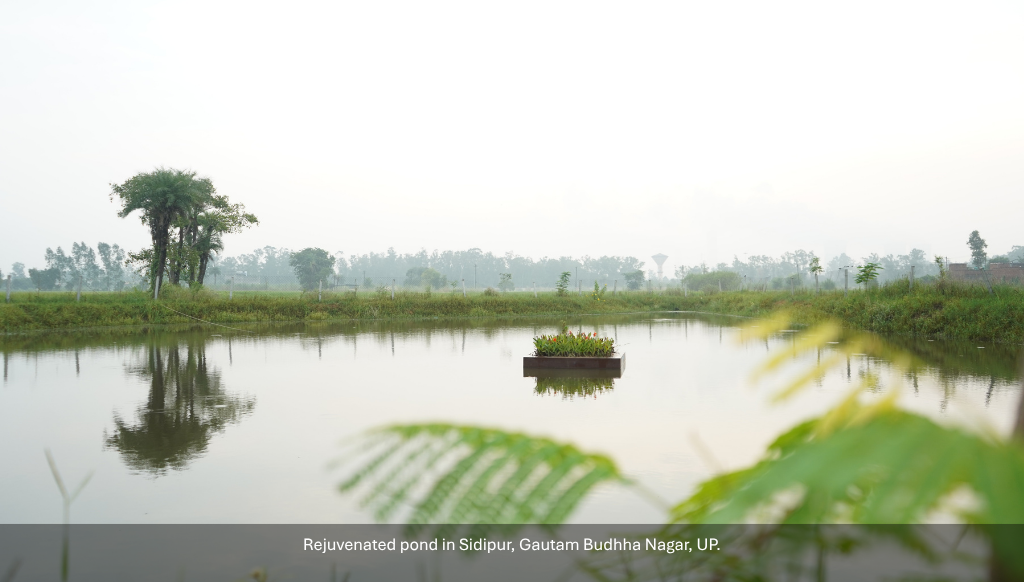
Water has never existed in isolation. It travels through forests, flows into rivers, seeps into healthy soils to replenish aquifers, and moves across landscapes that manage floods, droughts, and the livelihoods of people. For centuries, India recognised these natural connections. Ponds, streams, wetlands, forests, and rivers were not seen as separate entities but as part of an interconnected ecological network that supports communities, economies, and cultures.
At some point, we started to perceive them in a different way.
As our cities expanded and landscapes transformed, many natural systems have been fragmented or removed entirely. Local water channels that once carried monsoon flows have been encroached upon, wetlands have disappeared beneath concrete, and village ponds have steadily lost their place in local economies. The consequences are becoming increasingly apparent. Cities are experiencing recurring waterlogging because the ecosystems that once absorbed excess water have been degraded. Groundwater levels continue to decline despite growing investments, and rural communities are facing increasing uncertainty as traditional water systems lose both their ecological function and social relevance.
The challenge we face is not just about water scarcity; it is about the disconnect with our ecosystems.
Conversations about water security too often start with infrastructure and end with conservation. However, nature itself is our oldest and most reliable form of water infrastructure. Healthy ecosystems capture rainfall, regulate river flows, recharge groundwater, improve water quality, and protect communities from climate extremes. Therefore, protecting and restoring these systems is not just an environmental necessity; it is fundamental for climate resilience, sustainable development, and water security.
This systems perspective shapes Development Alternatives’ approach to natural ecosystem restoration.
Our experience has consistently shown that ecological restoration is successful only when communities move beyond mere participation to take on stewardship. Restoring a pond or revitalising a water channel is just the beginning; the long-term sustainability of these efforts depends on whether local institutions and communities continue to value, monitor, and manage these ecosystems long after the initial intervention has concluded. This is why our approach invests as much in people as it does in landscapes. We focus on strengthening Talab Samitis, equipping communities with scientific monitoring tools, and integrating restoration into local governance. When communities become custodians instead of just receivers, ecological restoration transitions from a one-time project into a lasting practice. It is equally important to recognise that landscape restoration cannot be accomplished everywhere at once. Lasting change begins in concentrated clusters where interconnected ecosystems and neighbouring communities can work together to create transformation.
This concentrated approach allows ecological improvements, community institutions, and governance mechanisms to reinforce one another while generating evidence of effective strategies. These landscapes become living laboratories from which proven approaches can be adapted, replicated, and expanded across larger geographies. Scaling, therefore, is not simply about increasing the footprint of an intervention; it is about multiplying resilient systems that are locally owned, scientifically informed, and ecologically sustainable.
This philosophy has enabled Development Alternatives to move beyond restoring individual waterbodies towards regenerating entire ecological landscapes. Through scientific assessments, participatory planning, and community-led governance, we have supported the restoration of 121 waterbodies while enhancing groundwater recharge, improving ecosystem health, strengthening biodiversity, and increasing resilience to climate variability.
Yet the true measure of success extends well beyond these numbers.
Across project landscapes, Pond Health Score Cards are enabling communities to monitor the health of their ecosystems. Talab Samitis are taking collective responsibility for managing restored waterbodies, and water quality monitoring is informing local decision-making. Equally significant is the effort to restore the economic and social value of these ecosystems. As village ponds gradually ceased to be viewed as productive assets, particularly by younger generations, community investment in their protection also declined. Reviving these waterbodies, therefore, is not merely an ecological effort; it is also about restoring their economic significance, strengthening local livelihoods, rebuilding cultural connections, and ensuring that future generations recognise these ecosystems as valuable assets worth protecting.
The stories featured in this edition demonstrate that resilient water systems cannot be engineered through infrastructure alone. They arise from the collaboration of science, policy, community institutions, and ecological restoration. Every restored pond reconnects a watershed, every revived water channel strengthens the landscape, and every empowered community safeguards the resilience of the next generation.
The future of water will not be ensured by merely building infrastructure around nature; it will be secured by building in harmony with nature. By embracing nature-based solutions, restoring interconnected ecosystems, empowering communities to become long-term stewards, and scaling locally proven models, we can move beyond managing water crises. Instead, we can create landscapes that are resilient, regenerative, and ready to face the challenges of a changing climate.
The views expressed in the article are those of the authors and not necessarily those of Development Alternatives.
This blog first appeared as an editorial in Development Alternatives Newsletter August 2026 Water for Tomorrow: Conservation and Resilience


Leave a Reply