

The Concrete Loop: Reclaiming ‘Development Minerals’ for India’s Urban Future
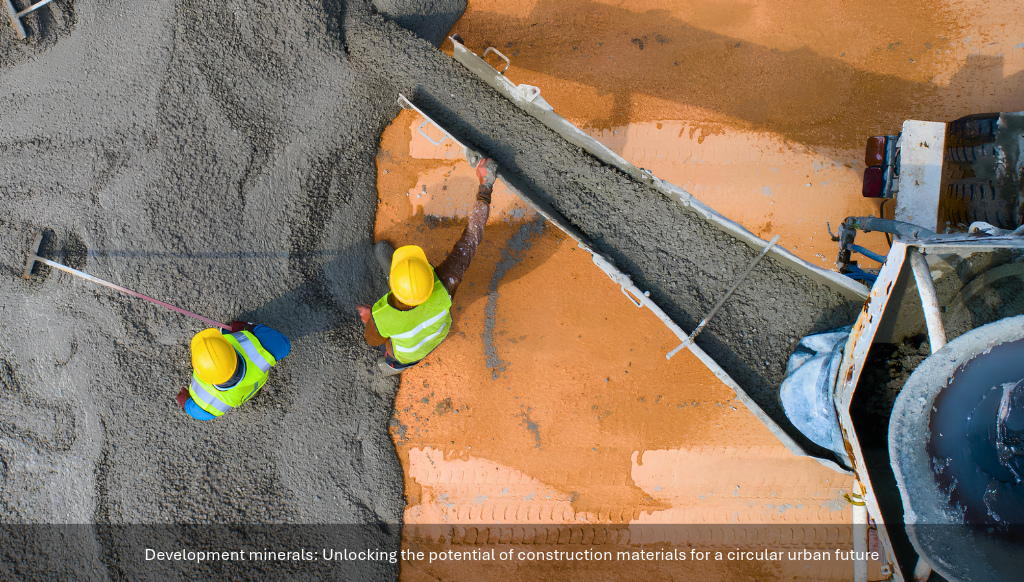
India’s rapid urban transformation is a relentless landscape of steel, concrete, and soil. As our metropolitan hubs expand, they consume massive quantities of virgin materials while generating approximately 150 million tonnes of construction and demolition (C&D) waste annually. Yet less than 1% of this debris is formally recovered, with the rest dumped in fragile ecosystems. To move the needle on sustainable urbanisation, we must look beyond standard municipal waste management and embrace circular economy pathways. We must treat urban-industrial debris not as a disposal liability but as a secondary resource repository of ‘development minerals’.
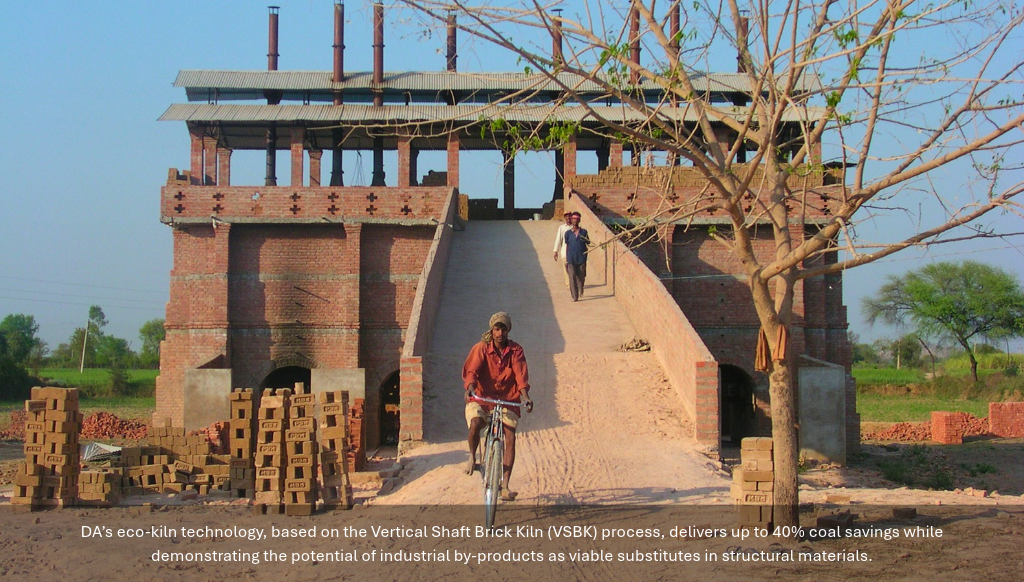
Development Alternatives (DA) has spent over three decades pioneering this exact resource-decoupling transition across India. From our iconic headquarters in New Delhi, where substituting virgin clay with fly ash and reusing demolished structural materials on-site reduced embodied energy by 30%, to our wider initiatives, our mission has been to green the built environment. Through TARA Machines, we have commercialised ‘Waste to Wealth’ business solutions, mainstreaming fly ash brick technologies that have saved over 274,000 tonnes of soil and 20,000 tonnes of coal while mitigating 63,000 tonnes of carbon emissions across states like Bihar. Our Eco-Kiln technology, based on the Vertical Shaft Brick Kiln (VSBK) process, further demonstrated up to 40% coal savings, proving that industrial by-products are highly viable structural substitutes.
Today, moving the needle demands scaling these closed-loop models into the complex realities of rapidly growing regional clusters. Our recent intervention in the Bhubaneswar–Cuttack corridor addresses a critical spatial and environmental challenge. Bhubaneswar alone generates 200 tonnes of C&D waste daily, much of it is dumped in municipal landfills at Patia and Kargil Road. By shifting from centralised processing to a decentralised, zero-hauling network, the local construction supply chain can cut heavy transport costs and replace primary river sand with recycled aggregates. This decentralised value chain reduces aggregate supply costs by up to 21% while directly safeguarding our rivers from sand mining.
Crucially, technical innovations are only half the battle. Sustainable cities require a human-centric, power-sensitive lens. DA’s work has historically proven that circularity must be tied to green livelihoods and social equity. This is exemplified by the TARA Karigar Mandal (TKM), our mutually aided cooperative society. TKM has successfully trained hundreds of masons in climate-resilient masonry techniques like the rat-trap bond, turning individual drudgery into dignified, secure green jobs.
In the Bhubaneswar corridor, this model translates into a participatory circular value chain. By integrating informal waste pickers and masonry networks into localised processing cooperatives, we aim to ensure that the transition to the 2025 C&D Waste Rules protects the most vulnerable actors. These circular pathways can help local suppliers meet public procurement requir-ements, including the proposed requirement to use 25% recycled content by 2031, while enabling workers to access formal social security benefits through the state’s welfare board.
Moving the needle on sustainable cities requires this precise integration of material science, industrial by-product recycling, and community-led governance. By treating the city as a materials depot, we do more than clean up waste; we decouple construction from ecological degradation and build inclusive liveli-hoods. True urban sustainability lies at this very intersection of technical validation and human dignity.
The views expressed in the article are those of the authors and not necessarily those of Development Alternatives.
This blog first appeared as an editorial in Development Alternatives Newsletter October 2026 Beyond Urban Growth: Building Resilient Cities and Regions


Leave a Reply